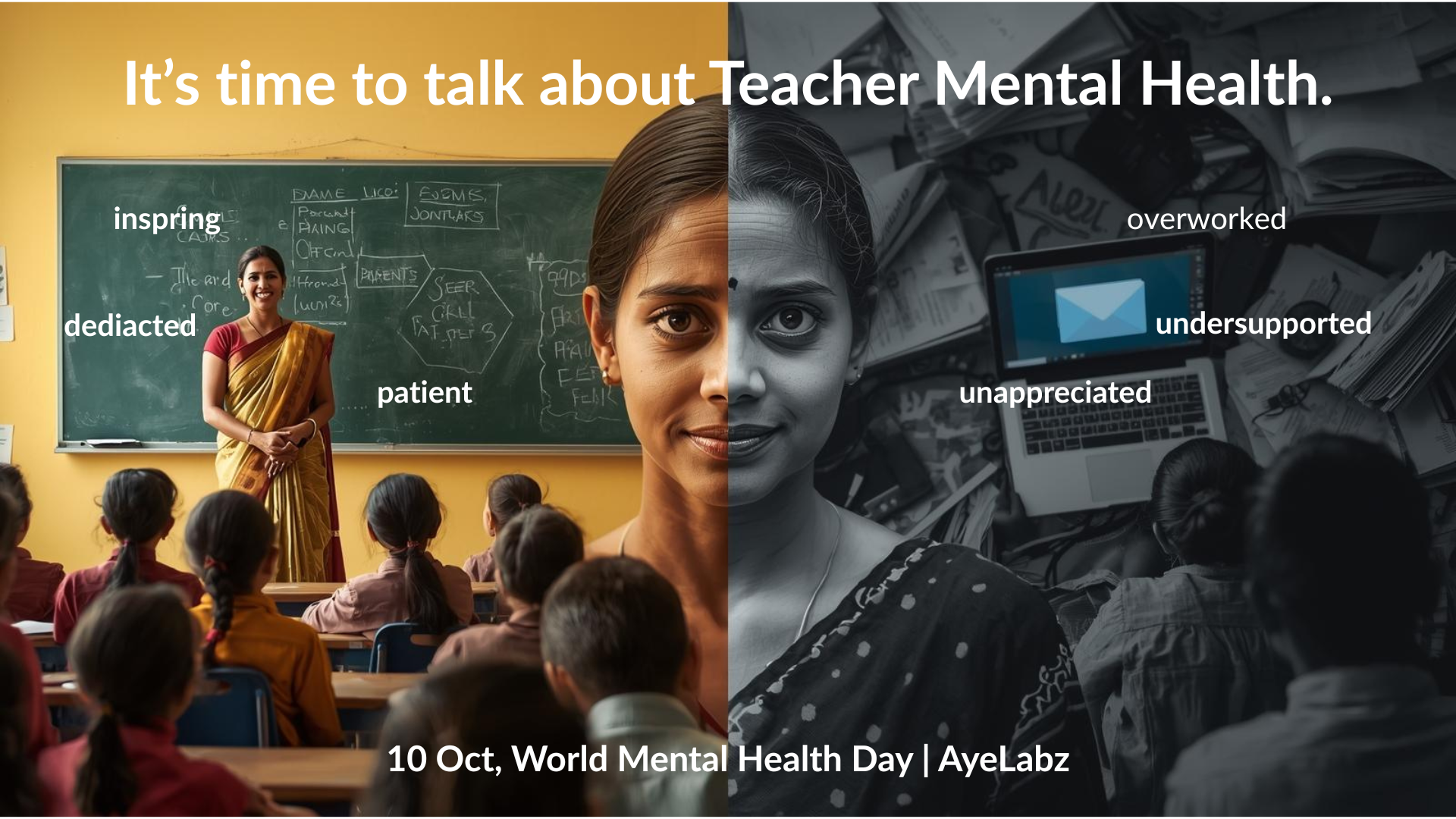
On 10 October, World Mental Health Day, we renew our collective promise: make mental health a global priority. Yet within classrooms across India, one group remains overlooked in most conversations: our teachers. While student well-being rightly gets attention (this also needs improvement!), teachers carry emotional, cognitive, and administrative burdens that rarely get addressed.
If we hope for mentally healthy students, we must begin by caring for those who teach them.
How Widespread Is Teacher Burnout? The Evidence Speaks
Globally and in India, teacher burnout is alarmingly common. A 2025 review of 67 global studies found that roughly 60% of teachers experienced signs of occupational burnout. In India, research suggests up to 44% of teachers report burnout symptoms like emotional exhaustion, depersonalization, and reduced sense of accomplishment. A review of Indian literature on teacher burnout highlights that excessive workload, low autonomy, unrealistic expectations, poor working conditions, and low compensation are consistent predictors.
These numbers illustrate a system in distress not because our teachers lack strength, but because the demands placed on them are unsustainable.
The Hidden Stressors Behind Burnout
When teachers share their experiences, several recurring themes emerge:
- Excessive administrative overload: paperwork, compliance, event planning, documentation that distracts from teaching.
- Lack of recognition or appreciation: efforts often go unnoticed unless something fails.
- Limited autonomy / decision-making power: implementing top-down policies rather than shaping them.
- Insufficient leadership support: managerial priorities sometimes prioritize metrics over people.
- Parent and societal scrutiny: educational decisions are under constant external judgment.
- Work–life conflict & emotional labor: managing student crises, emotional needs, and expectations beyond teaching.
- Tech / hybrid demands: adapting to digital tools without adequate support. For example, in low-income schools, teachers have had to build informal support networks to cope with sociotechnical stress.
In India, many teachers report that administrative tasks have grown so burdensome they feel like event managers or data entry personnel, leaving little space for pedagogical work. These stressors, individually may seem manageable, but cumulatively they erode morale, agency, and mental resilience.
The Ripple Effects: Why Teacher Well-Being Matters
Burnout isn’t an isolated problem, its consequences ripple outward.
On Teachers
- Chronic stress, anxiety, depression, sleep issues, and physical health decline
- Reduced job satisfaction and professional engagement
- Higher attrition rates – teachers quitting or leaving the profession prematurely
On Students & Classrooms
- Decline in instructional quality and creativity
- Lower student motivation and engagement
- Less emotional safety in classrooms
- Disrupted continuity when teachers leave or are absent
On Schools & Systems
- Higher costs of recruitment, training, and replacements
- Institutional instability
- Erosion of trust, morale, and school climate
Research consistently shows that teacher well-being is directly tied to classroom climate, student outcomes, retention, and school effectiveness. Thus, caring for teachers is not a luxury, it’s essential for a healthy education ecosystem.
Interventions That Work: A Multi-Level Approach
At the School / Institutional Level
- Teacher Well-Being Committees / Wellness Cells
Small groups (teachers, counselors, admin) can hold regular non-evaluative check-ins, peer sharing, and teachers’ mental health conversations.
- Anonymous Well-Being Surveys
Use validated tools (e.g. Maslach Burnout Inventory, Teacher Subjective Well-Being Questionnaire) to measure stress levels and track impact over time.
- Reduce Administrative Burden
Automate documentation, hire dedicated clerical support, minimize redundant tasks so teachers can focus on teaching.
- Empower Teachers in Decision-Making
Involve educators in policy formation, curriculum planning, parent-school strategy to restore agency.
- Recognition & Appreciation Systems
Regular acknowledgment (letters, assemblies, peer shoutouts) builds morale and belonging.
- Access to Mental Health Resources / Professional Support
Periodic sessions with counselors, “mental health days,” confidential helplines.
- Peer Support & Communities of Practice
Structured peer circles, mentorship, and safe spaces for vulnerability and sharing.
At the Policy / System Level
- Embed Well-Being in Education Policy
NEP 2020 emphasizes teacher development but needs an explicit mental health mandate.
- Allocate Funding for Wellness Programs
Grants for schools to hire counselors, support wellness initiatives, train staff in emotional resilience.
- Integrate Mental Health Modules into Teacher Education
B.Ed. or M.Ed. and in-service programs should include coping strategies, emotional intelligence, self-care.
- Establish Workload Norms & Caps
Define limits on administrative tasks, class size ratios, avoid overburdening teachers.
- Monitor & Evaluate Well-Being Outcomes
National and state education bodies should track teacher mental health trends, publish data, and act accordingly.
At Community / Societal Level
- Empathy in Parent-Teacher Relations
Encourage collaboration rather than criticism. Recognize that teachers share the goal of student growth.
- Public Awareness & Media Narrative Shift
Highlight teaching as emotionally demanding, not just transactional. Celebrate patience, compassion, resilience.
- Civil Society / NGOs Partnerships
NGOs, mental health organizations, and education advocates can support wellness initiatives, peer networks and advocacy.
Call to Action: What You Can Do Today
- If you’re a school leader: Start a wellness committee, run an anonymous survey, or pilot mental health check-ins.
- If you’re a teacher: Share your experiences, seek peer support, advocate for change in your institution.
- If you’re a policymaker / NGO: Push for teacher well-being to be part of education policies, funding, and accountability.
- If you’re a parent / community member: Recognize the emotional labor teachers do; express gratitude; support initiatives that shift policy.
Let’s make this conversation public, collective, and sustained. Share this post, tag educators you know, and let’s hold institutions accountable not just individuals.
FAQs
Q: What is teacher burnout?
Teacher burnout is a state of chronic emotional, physical, and mental exhaustion caused by prolonged stress at work, often characterized by emotional depletion, depersonalization, and reduced effectiveness.
Q: Why do teachers in India suffer burnout?
Key causes include excessive administrative workload, limited autonomy, lack of leadership support, emotional labor, societal pressures, and inadequate institutional resources.
Q: How does teacher mental health affect students?
Teachers’ well-being shapes classroom climate, instructional quality, student engagement, retention, and even learning outcomes. Burned-out educators are less able to create emotionally safe, inspired learning spaces.
Q: What can schools do to reduce teacher stress?
Schools can form wellness committees, reduce non-teaching workload, empower teachers, offer mental health support, and build systems of recognition.
Q: How can teachers care for themselves amid systemic pressures?
They can build peer support networks, practice self-care and boundaries, seek counseling, communicate with leadership, advocate collectively, and use tools (journaling, mindfulness) for emotional regulation.
Conclusion
Teachers’ mental health is not ancillary it is foundational to a thriving educational system. When teachers are overworked, under-supported, and emotionally strained, the costs are borne not just by them, but by students, schools, and society.
This World Mental Health Day, 10 October, let us shift the lens: “Who cares for those who care for our children?”
Let this be the start of collective action and not individual burden. Let’s talk, share, advocate, and build institutions and policies that teach care as a responsibility, not a favor.
If you’re an educator, leader, policymaker, or parent we invite you to comment and share:
What’s one change your school or community has taken or plans to take to support teacher well-being? Let’s begin a playbook together.



Recent Comments