Introduction
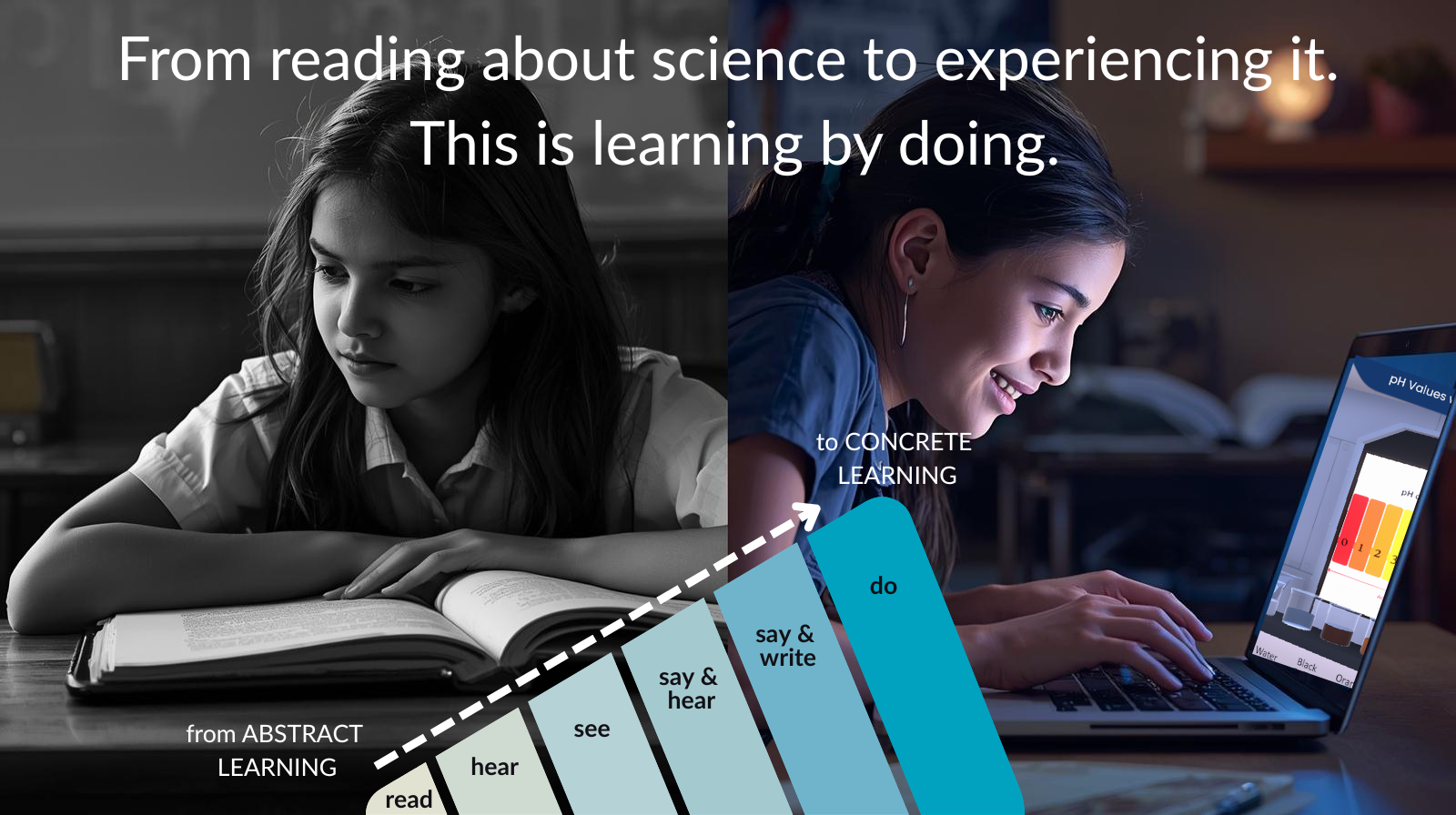
In 1946, Edgar Dale offered a powerful insight: “We learn best when we connect ideas to experience.” His Cone of Experience wasn’t about fixed percentages or memorization, it was a continuum stretching from the abstract (lectures, reading) to the concrete (doing, creating).
Over time, however, Dale’s message has been diluted. Many classrooms today look high-tech, but learning often remains passive: a video shown, a quiz given and yet little chance for students to experiment, test, observe, or discover.
ScholarLab by AyeLabz aims to restore the original spirit of Dale’s vision. It’s not about just visualizing processes, it’s about making them happen.
1. Reclaiming Dale’s Continuum: From Abstract to Experiential
- Dale’s model is a continuum of representation, not a ladder of fixed learning-retention percentages.
- He emphasized movement from symbols → demonstrations → direct experience, not rigid levels.
- It’s about depth of understanding and connection, rather than simply more engaging visuals.
1.2 Why the Distortion Hurts Learning
- When “activity” is mistaken for “engagement,” the focus shifts to doing things, not understanding them deeply.
- Visuals & animations are useful but without interactivity, parameter changes & reflection, they remain passive.
- Misinterpretation leads many EdTech tools to fill up the symbolic side of Dale’s continuum, leaving the experiential side under-utilized.
2. The Gap in Modern Tools & The Need for True Experiential Learning
- Many platforms gamify content or provide simulations but limit interactivity (fixed scenarios vs. parameterized experiments).
- True experiential learning means letting students manipulate variables, test hypotheses, observe outcomes, make mistakes safely, and reflect. This cycle is essential.
- According to definitions of experiential learning, it includes reflection, critical analysis, and applying knowledge in real contexts.
3. ScholarLab: Virtual Science Lab for Experiential Learning – Bridging Concept and Experience
3.1 What ScholarLab Does Differently
- Offers 135+ immersive simulations spanning 500+ science concepts (Physics, Chemistry, Biology) for Grade 6 to 12.
- Real-life scenario framing to show relevance beyond textbooks
- High parameterization & randomization so each experiment feels unique and encourages critical thinking over rote repetition
- Built-in tools: virtual notebooks, integrated quizzes, flexible mapping across curricula
3.2 Pedagogical Flow (Aligned with Dale’s Continuum)
Teachers using ScholarLab can follow a scaffolded progression:
- Introduce concept with visuals / symbolic representation
- Demonstrate via guided simulation
- Let students explore by altering variables & observing outcomes
- Reflect through assessment, discussion, and teacher feedback
This flow helps ensure learning is deep and experiential.
3.3 Versatility & Context
- Suited for Grade 6 through Grade 12, across curricula like CBSE, IGCSE, etc.
- Works in online, offline, hybrid learning environments.
- Developed using engines like Unity & Unreal, for immersive and dynamic simulations.
4. Impact, Recommendations & Next Steps
- Learning becomes more understanding-oriented rather than memorization-oriented.
- Students are more curious, testing hypotheses and engaging in inquiry.
- Teachers have tools to make abstract ideas tangible.
Recommendations for educators & stakeholders:
- Choose platforms that facilitate doing not just observing.
- Build in reflection and discussion as part of every learning cycle.
- Reward inquiry, exploration, and critical thinking both in teaching practice and assessment policies.
- Invest in training and infrastructure and not just devices, but content ecosystems.
If your school or institution is rethinking how science should be experienced, not just explained, we would love to show how ScholarLab is supporting transformations in real classrooms. → Request for Demo or write to us at hello@ayelabz.com
FAQ / Voice-Search Ready Section
Q: What is the Cone of Experience?
A: Edgar Dale’s Cone of Experience is a continuum showing how learning progresses from abstract (words, symbols) to more concrete, sensory experiences. It’s about how representation affects understanding more than rote retention.
Q: Why numbers (like 10-20-90%) are not in Dale’s original model?
A: Those retention-percentage figures are later distortions or amendments made by other scholars. Dale’s original model did not include fixed memory retention values. Scholars warn against treating those numbers as factual.
Q: How does ScholarLab make learning more experiential?
A: Scholarlab, Virtual Science Lab for Experiential Learning, offers an immersive, 3D interactive virtual lab, parameterized simulations where students can change variables, test hypotheses, observe outcomes, reflect, and apply concepts in real-world contexts, all scaffolded into pedagogical flow.
Q: Can this platform work with Indian and International curricula?
A: Yes. ScholarLab is designed to align with major curricula (like CBSE, ICSE, Indian State boards, IGCSE, NGSS, etc), across multiple grade levels, and in blended or hybrid learning environments. Scholarlab content library.



Recent Comments