

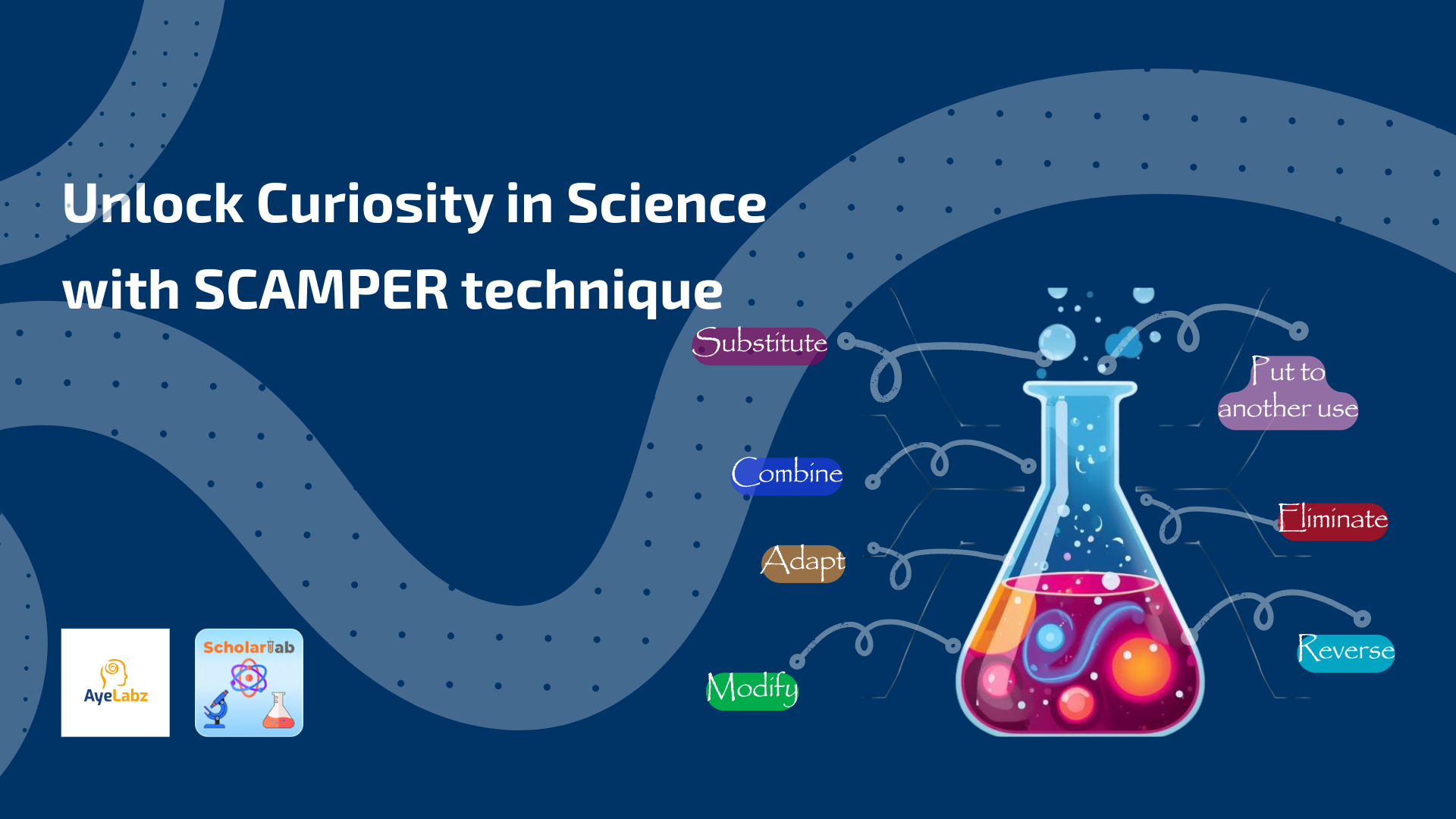
Discover how the SCAMPER framework can revolutionize science classrooms by turning rote experiments into explorations. Learn how Scholarlab empowers students to think creatively, test ideas, and embrace inquiry-driven science learning.
For decades, science classrooms have been built around predictability:
But when learning becomes predictable, curiosity fades. And at its core, science is not about answers, it’s about questions.
That’s where the SCAMPER framework steps in. Originally designed as a creative thinking tool, SCAMPER helps learners and innovators push boundaries by systematically asking, “What if?” Paired with digital learning platforms like Scholarlab, SCAMPER can reimagine how science is taught, shifting classrooms from rote memorization to inquiry-driven exploration.
SCAMPER is a structured ideation tool developed to inspire creativity and innovation. The acronym stands for seven thinking prompts:
Each prompt challenges learners to approach problems differently. Instead of simply following a formula, students are encouraged to question assumptions, redesign processes, and discover new possibilities.
In many ways, SCAMPER mirrors the essence of scientific inquiry: constant questioning and reimagining.
Science thrives on curiosity. The SCAMPER method provides a structured framework for curiosity by nudging students to alter variables, combine phenomena, or imagine reversals.
Here’s how it can reshape science education:
Even education boards like CBSE (India), through its 21st Century Skills Handbook, recommend SCAMPER and related creativity boosters (“Wrong is Right,” “Image Talk”) to nurture student imagination.
Here’s how each SCAMPER step can be applied in a classroom setting:
Such activities transform science into exploratory learning rather than repetitive demonstrations.
At AyeLabz, we developed Scholarlab, a DIY science simulator that empowers students to explore science beyond fixed procedures. Instead of merely running standard experiments, learners can:
This aligns seamlessly with SCAMPER:
In short, Scholarlab operationalizes SCAMPER turning theory into practice.
When SCAMPER and Scholarlab converge in classrooms, something powerful happens:
This shift prepares learners for a world that values adaptability, critical thinking, and creativity just as much as factual knowledge.
Of course, reimagining classrooms isn’t without challenges:
Yet, these challenges are opportunities for innovation in pedagogy and policy.
The future of science classrooms doesn’t lie in replicating old experiments, it lies in creating new ones.
The SCAMPER framework offers a way to unlock curiosity, while Scholarlab provides a digital space where exploration is limitless, safe, and engaging.
At AyeLabz, we believe every student deserves the chance to not just learn science, but to play with it, question it, and make it their own.

Recent Comments